

Exoplanets are planets that orbit stars outside of our own solar system. But today, we are going to learn about the exoplanet Iota Draconis b.
Iota Draconis b is a super-Jupiter exoplanet that orbits a host star and has two other planets. It was the first planet discovered around a star. Type: Super-Jupiter gas giant. The Iota Draconis system is about 101 light-years away from Earth.
The host star, Iota Draconis, is visible to the naked eye. The host star Iota Draconis, which is also known as Edasich, is orbited by at least two gas giant exoplanets. The names of the two giants were Iota Draconis c and Iota Draconis b. The system is notable for having gas giants orbiting a red giant star, and it is 2.5 billion years old.
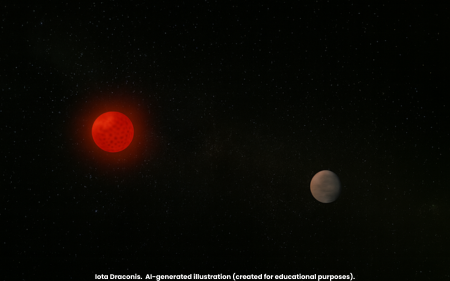
As you can see, this is a picture of it so that you don’t have to imagine it.
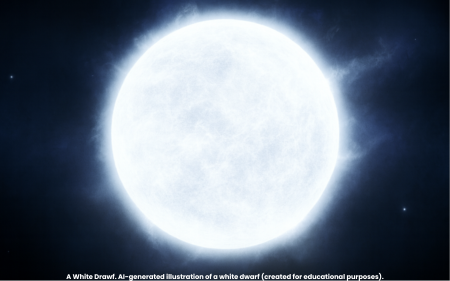
I know you all might be thinking the name of this big red giant, you don’t have to, because it’s Iota Draconis itself. Its mass is 16.4 times the mass of Jupiter. The Iota Draconis system won’t exist in its current form for much longer. The star, being in its giant phase, will eventually lose much of its mass into space as it nears its final stages. It will likely shed its outer layers as a planetary nebula, leaving behind a white dwarf. I know you all might be imagining it like a snow-white dwarf, but nooo…!
This is what it looks like. A white dwarf is the hot, dense remnant of a star that has exhausted its nuclear fuel, with planets potentially surviving around it as they orbit. They are about the size of Earth, but contain up to half the mass of the Sun, making them incredibly dense. Because they have no nuclear fusion, their energy comes from stored thermal energy, and they slowly cool down over billions of years. Ultimately, they are predicted to become cold, dark “black dwarfs,” although the universe is not yet old enough for any to exist. Astronomers have detected planets orbiting white dwarfs. One example is a Jupiter-sized planet in a close orbit around a white dwarf. Other systems have debris disks, which could be the remnants of planets that were torn apart by the white dwarf’s gravity.